 In Washington farewell address, he not only thanks the American people, but he also gives them advice as to how they can keep America cohesive and a great nation. He plants the idea that America is stronger as a unified nation. He states that they should not let either foreign nations or angry American political parties divide or misguide America and its people. In order to preserve liberty and the union, Washington recommends that the people spread knowledge, religious piety, and morality.
Wednesday, September 25, 2013
LAD #7: Washington’s Farewell Address
Summary of Washington’s Farewell Address:
In Washington farewell address, he not only thanks the American people, but he also gives them advice as to how they can keep America cohesive and a great nation. He plants the idea that America is stronger as a unified nation. He states that they should not let either foreign nations or angry American political parties divide or misguide America and its people. In order to preserve liberty and the union, Washington recommends that the people spread knowledge, religious piety, and morality.
In Washington farewell address, he not only thanks the American people, but he also gives them advice as to how they can keep America cohesive and a great nation. He plants the idea that America is stronger as a unified nation. He states that they should not let either foreign nations or angry American political parties divide or misguide America and its people. In order to preserve liberty and the union, Washington recommends that the people spread knowledge, religious piety, and morality.


LAD #6: Washington’s Proclamation of Neutrality
Summary of Washington’s Proclamation of Neutrality:


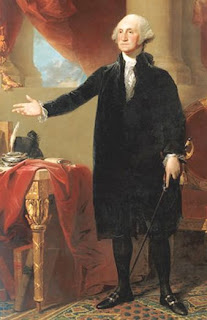
Washington declared the country neutral order to prevent participation of the United States government and people in wars. Citizens were warned by Washington that if they engage in hostilities with any European nation they will lose protection from the United States. Also, they will be liable to forfeit and punishment under the law of nations.
Tuesday, September 24, 2013
LAD #5: The Federalists #10
1. Why are factions so difficult to eliminate?
Factions are difficult to emiminate because they are sort of like political parties. Different factions have different political views therefore opposing opinions come up when discussing an issue. Tensions run high between factions and that is why they are hard to eliminate.

2. If factions cannot be removed then how can they be controlled?
|
Factions can not be removed because then liberty is being taken away. If factions are controlled to much, everyone in society will have to form one opinion. The best way to control factions is to have a large republic with an ample amount of candidates and voters
Sunday, September 22, 2013
Blog: Republican Motherhood
1.) What
role did the Revolutionary War play in the transformation of housewife to Republican Motherhood?
After the Revolutionary War, people began
to think that women should be taught simple math, how to write, and the basics
of the English Language (Document B). Women had to be educated so that they
could teach their sons about the government and principles of liberty (Document
B).
2.)
What were the consequences of
Republican Motherhood on women?
Women started to gain respect
and they were the ones who educated their children and taught them their morals
(Document D). Home is a "nursery of the future man and of the undying
spirit; and women is the nurse and educator (Document A).
3.)
What is the significance of the ideology of Republican
Motherhood as a stage in the process of women’s socialization?
Women
did not have to leave the house much, but it was expected that their house was
welcoming. Despite the fact that their physical appearance was not important,
their influence on society was very important (Document D).
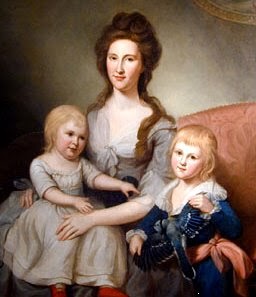 Picture description: The woman in the center of the portrait is Mary Gibson Tilghman, the mother of the
two children also in the picture. She is dress modestly and conservatively meaning she was probably a republican. Her sons are dresses well and have good posture indicating their morals and good behavior. Mary's arm around her son shows the viewer that she was caring
and loved her children very much.
Tuesday, September 17, 2013
LAD #4: Revolution Article
Five things I learned from Rethinking the Revolution...
1.) Over six hundred and twenty thousand soldiers were killed in the Civil War. It is the highest death toll of American Soldiers in any war. “Popular interest in the Civil War surpassses that for any other event in American history.” Many people are interested in it because of the bloody battles that were faught.
2.) To many historians, the Civil War, is known as the first modern war because cameras enabled the events to be captured and saved unlike previous wars where there are no pictures, only written records and drawings. The slaughterhouse aspect is one factor that draws people to the Civil War. Issues that were also at stake included slavery, self-government, and the survival of the United States.

3.) Videos and film played a large role during World War II and the Vietnam War. Throughout World War II, short, seven to ten minute, black and white films were played in the American theaters to bring news from the front lines home. Then, during the Vietnam War film footage was broadcasted in vivid color on the television. Vietnam was America’s first television was.
4.) Civil War soldiers were equipt with weapons that were capable of producing more casualties the General Washington’s soldiers during the Revolutionary War. Union and Confederate soldiers had rifles with effective aim and nearly six times better than the men in the Continental Army.
5.) The Revolutionary War was a civil war within a civil war. The Anglo-Americans were fighting the British while the American Tories and the Whigs faught one another. On top of that, the civilians had vendettas against one another. General Nathaneal Greene, the last commander of the Continental army in the South, said that Southern civilians “persecute each other, with little less than savage fury. There is nothing but murders and decastations in every quarter."
1.) Over six hundred and twenty thousand soldiers were killed in the Civil War. It is the highest death toll of American Soldiers in any war. “Popular interest in the Civil War surpassses that for any other event in American history.” Many people are interested in it because of the bloody battles that were faught.
2.) To many historians, the Civil War, is known as the first modern war because cameras enabled the events to be captured and saved unlike previous wars where there are no pictures, only written records and drawings. The slaughterhouse aspect is one factor that draws people to the Civil War. Issues that were also at stake included slavery, self-government, and the survival of the United States.

3.) Videos and film played a large role during World War II and the Vietnam War. Throughout World War II, short, seven to ten minute, black and white films were played in the American theaters to bring news from the front lines home. Then, during the Vietnam War film footage was broadcasted in vivid color on the television. Vietnam was America’s first television was.
4.) Civil War soldiers were equipt with weapons that were capable of producing more casualties the General Washington’s soldiers during the Revolutionary War. Union and Confederate soldiers had rifles with effective aim and nearly six times better than the men in the Continental Army.
5.) The Revolutionary War was a civil war within a civil war. The Anglo-Americans were fighting the British while the American Tories and the Whigs faught one another. On top of that, the civilians had vendettas against one another. General Nathaneal Greene, the last commander of the Continental army in the South, said that Southern civilians “persecute each other, with little less than savage fury. There is nothing but murders and decastations in every quarter."
Monday, September 16, 2013
LAD #3: Declaration of Independence
 1.) Summary of the democratic principles
One democratic principle stated in the Decloration of Independence is that all men have certain unalienable rights, which are, life, liberty, and the pursuit of happiness. Also, a majority of the power came from the people and if the people were unhappy they had the ability to change it.
2.) A list of grievances
There are many grievances listed in the Decloration of Independance. For example, one reason the colonists were mad is because the British cut off their trade with all parts of the world by implmenting mercantilism. Also, the British imposed taxes on them without their consent. "No taxation, without representation." And, the colonists felt deprived in many ways, especially in trial by jury.
3.) Summary of the conclusion
In the conclusion, the colonists were now independent form Britain which gave them the right to make their own alliences and declare war. This brought the colonists together because they could make their own rules.
Sunday, September 8, 2013
LAD #2 Zenger Trial
1.) Who was John Peter Zenger?
John Peter Zenger was a native German who moved to the New York colony. In the latter part of 1733, Zenger started publishing a newspaper to voice his dissent about the arduous policies of the colonial governer William Cosby. On Sunday, November 17, 1734 he was arrested and charged with seditious libel.
2.) What was the controversy over his charges? Talk about Hamilton's defense.
Zengers arrest and charges of seditious libel caused controversy because the case challenged the ideas of the freedom of the press. The prosecution thought Zenger should be convicted and found guily because of his reputation tarnishing stories about Cosby. However, Andrew Hamiltom, Zengers lawyer, pleaded that the stories were true and not libel. Therefore, the case challenged the idea of the freedom of the press.
3.) What influence did his case have on American governmental tradition?
The Zenger case influenced traditional American government because it set a precedent saying that the press can speak out and freely oppose the government. In addition to setting a precedent against judicial tyranny, it also showed one can use truth as a defense against libel suits.
4.) What is the lasting significance of his trial? Explain.
The most signifigant lasting effect of the Zenger case was the advancement made in the freedom of press. After the case, any person could critique the government as long as the story had truth in it.
 |
| Zenger’s New York Weekly Journal |
2.) What was the controversy over his charges? Talk about Hamilton's defense.
Zengers arrest and charges of seditious libel caused controversy because the case challenged the ideas of the freedom of the press. The prosecution thought Zenger should be convicted and found guily because of his reputation tarnishing stories about Cosby. However, Andrew Hamiltom, Zengers lawyer, pleaded that the stories were true and not libel. Therefore, the case challenged the idea of the freedom of the press.
3.) What influence did his case have on American governmental tradition?
The Zenger case influenced traditional American government because it set a precedent saying that the press can speak out and freely oppose the government. In addition to setting a precedent against judicial tyranny, it also showed one can use truth as a defense against libel suits.
 |
| 1730’s - Courtroom during the Zenger Trial Andrew Hamilton (Zengers lawyer) uses truth to get the jury to find Zenger not guilty |
The most signifigant lasting effect of the Zenger case was the advancement made in the freedom of press. After the case, any person could critique the government as long as the story had truth in it.
Subscribe to:
Posts (Atom)